
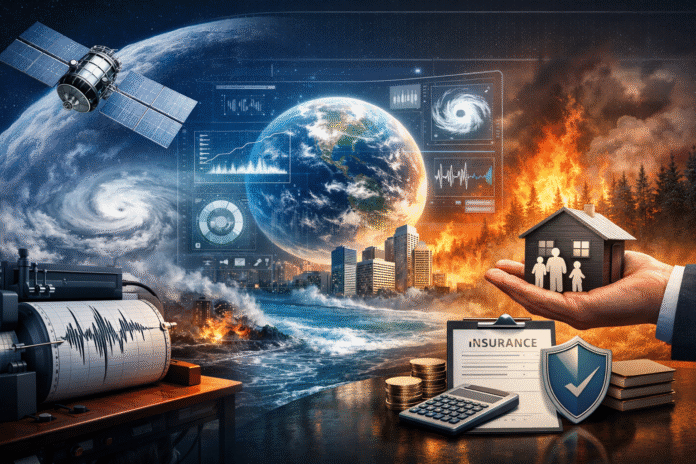
Natural catastrophes are no longer uncommon or surprising occurrences. Extreme occurrences, such as hurricanes, floods, wildfires, and earthquakes, are happening more frequently and with greater intensity. As the economic and human costs rise, predicting natural disasters has become a major concern for scientists and the insurance sector, which are essential to risk mitigation and financial recovery.
This article explores how modern science predicts natural disasters, how insurance companies use these insights, and why the collaboration between science and insurance is reshaping global resilience.
Understanding Natural Disaster Prediction
Predicting natural disasters involves identifying patterns, monitoring environmental signals, and using advanced models to estimate the likelihood, location, and severity of extreme events.
Key Scientific Tools Used in Disaster Prediction
Scientists rely on a combination of technologies and data sources, including:
- Satellite imagery to track storms, wildfires, and tectonic shifts
- Seismic sensors to detect earthquake precursors
- Weather radar systems for real-time atmospheric monitoring
- Ocean buoys to measure sea surface temperatures and wave activity.
- Machine learning models to analyze historical disaster data
These tools do not eliminate uncertainty, but they significantly improve early warning systems and risk assessments.
The Role of Climate Science in Disaster Forecasting
Climate science has transformed how we understand disaster risk. Long-term climate models help predict trends such as rising sea levels, prolonged droughts, and stronger tropical storms.
Climate Change and Disaster Frequency
Research consistently shows that climate change is intensifying many natural hazards. For example:
- Warmer oceans fuel stronger hurricanes.
- Higher temperatures increase wildfire risk.
- Changing rainfall patterns lead to severe flooding.
By incorporating climate projections, scientists can estimate future disaster scenarios rather than relying solely on past events.
How Insurance Companies Use Disaster Prediction
The insurance industry depends heavily on accurate disaster prediction to remain financially sustainable. Insurers use scientific data to price risk, design coverage, and manage exposure.
Catastrophe Modeling in Insurance
Catastrophe (CAT) models combine:
- Hazard data (earthquakes, floods, storms)
- Exposure data (properties, infrastructure, population)
- Vulnerability data (building materials, construction quality)
These models help insurers estimate potential losses and determine premiums more accurately.
Predictive Analytics and Risk-Based Pricing
Advanced predictive analytics allow insurers to move beyond generalized risk zones. Instead of pricing entire regions the same way, insurers can assess property-level risk, considering factors such as elevation, proximity to fault lines, and local building codes.
This approach benefits both insurers and policyholders by encouraging:
- Smarter urban planning
- Stronger construction standards
- Incentives for risk reduction
The Human Impact of Better Disaster Prediction
Accurate predictions save lives. Early warning systems give communities time to evacuate, prepare emergency resources, and reduce damage.
Disaster Prediction and Public Safety
When governments, scientists, and insurers share data:
- Emergency response improves
- Recovery funds are deployed faster.
- Vulnerable populations receive targeted support.
Insurance payouts, informed by scientific modeling, accelerate rebuilding and economic recovery after disasters.
Challenges in Predicting Natural Disasters
Despite technological advances, disaster prediction is not perfect.
Key Limitations
- Earthquakes remain difficult to predict precisely.
- Climate models involve uncertainty.
- Data gaps exist in developing regions.
- Extreme events may exceed historical patterns.
These challenges highlight the importance of continuous research and global data collaboration.
The Future of Disaster Prediction and Insurance
The future lies in deeper integration of artificial intelligence, real-time data, and cross-industry collaboration.
What’s Next?
- AI-driven forecasting models with higher accuracy
- Parametric insurance triggered by scientific thresholds
- Greater transparency in risk communication
- Stronger partnerships between insurers, governments, and scientists
As prediction improves, insurance will shift from reactive recovery to proactive risk prevention.
Conclusion
Predicting natural disasters is no longer just a scientific challenge—it is a cornerstone of modern insurance and global resilience. By combining climate science, advanced modeling, and insurance expertise, societies can better anticipate risks, protect lives, and recover faster from extreme events.
The collaboration between science and insurance represents one of the most powerful tools we have to face an uncertain natural future with greater confidence.