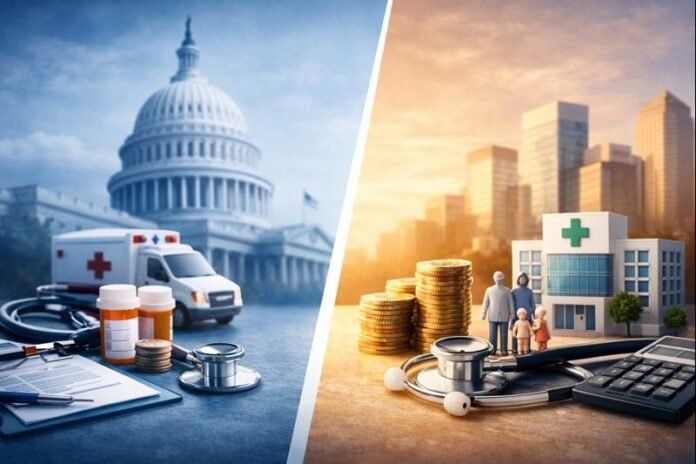
The debate over public vs private insurance has become one of the most polarizing political discussions of our time. At its core, the argument isn’t just about healthcare systems—it’s about values, economics, personal freedom, and the role of government in everyday life.
As healthcare costs rise and populations age, countries across the world are re-examining how insurance should be structured, funded, and delivered. Supporters on both sides claim their preferred model offers better access, efficiency, and fairness. But the truth, as usual, is more complex.
This article breaks down the political debate between public and private insurance, exploring the ideological foundations, real-world outcomes, and what the future may hold.
Understanding Public Insurance
Public insurance refers to healthcare coverage that is funded and administered by the government. The NHS in the UK, Medicare and Medicaid in the US, and universal healthcare programs in nations like Sweden and Canada are a few examples.
Key Features of Public Insurance
- Funded primarily through taxation
- The government sets prices and coverage standards.
- Universal or near-universal eligibility
- Emphasis on equity and access
Political Arguments in Favor
Proponents—often aligned with progressive or left-leaning political ideologies—argue that healthcare is a fundamental human right, not a market commodity. From this perspective, public insurance ensures:
- Equal access regardless of income or employment
- Lower administrative costs
- Stronger bargaining power to control drug prices
- Reduced medical bankruptcies
Politically, public insurance is often framed as a moral obligation of a modern state.
Understanding Private Insurance
Private insurance is provided by for-profit or non-profit companies, typically purchased by individuals or offered through employers.
Key Features of Private Insurance
- Premiums paid by individuals or employers
- Market competition among insurers
- Tiered coverage options
- Greater consumer choice
Political Arguments in Favor
Supporters—often associated with conservative or market-oriented politics—argue that private insurance promotes:
- Innovation and efficiency through competition
- Faster access to specialized care
- Greater individual choice and customization
- Less government bureaucracy
From this viewpoint, government-run insurance risks inefficiency, long wait times, and reduced incentives for innovation.
Why Public vs Private Insurance Is a Political Debate
The public vs private insurance debate persists because it reflects deeper political disagreements.
1. Role of Government
Should the government guarantee healthcare, or regulate it?
Public insurance supporters say “guarantee.” Private insurance advocates say “regulate, not run.”
2. Individual Responsibility vs Collective Welfare
Private insurance emphasizes personal responsibility and choice.
Public insurance prioritizes shared risk and social solidarity.
3. Economic Philosophy
Free-market advocates trust competition.
Social welfare advocates trust centralized negotiation and public oversight.
These philosophical divides ensure the debate remains political, not just technical.
Comparing Outcomes: What Does the Evidence Say?
Interestingly, countries with mixed systems—combining public and private insurance—often achieve the strongest outcomes.
Public-Heavy Systems Tend to Show:
- Lower per-capita healthcare spending
- Universal coverage
- Better population-level health metrics
Private-Heavy Systems Often Show:
- Faster access to elective procedures
- Greater technological innovation
- Higher patient satisfaction among higher-income groups
No system is flawless. Each involves trade-offs shaped by political priorities.
The U.S. as a Case Study
The United States embodies the public vs private insurance political debate more intensely than almost any other nation.
- Medicare and Medicaid represent public insurance.
- Employer-based and individual plans dominate the private sector.
Healthcare reform debates—such as the Affordable Care Act, Medicare expansion, or “Medicare for All”—highlight how divided public opinion remains. Elections routinely hinge on where candidates stand on this issue.
Common Myths on Both Sides
Myth 1: Public Insurance Eliminates Choice
In reality, many public systems allow provider choice while standardizing coverage.
Myth 2: Private Insurance Always Means Better Care
Higher cost does not automatically equal higher quality.
Myth 3: One System Fits Every Country
Healthcare systems must align with cultural norms, economic capacity, and political structures.
The Future of the Public vs Private Insurance Debate
As technology advances and healthcare costs continue rising, the debate is shifting. New models are emerging:
- Public insurance with private delivery
- Regulated private markets with universal mandates
- Value-based care replacing fee-for-service
Rather than choosing one extreme, many policymakers now focus on hybrid solutions that balance efficiency with equity.
Final Thoughts
The public vs private insurance political debate is not simply about healthcare—it’s about how societies define fairness, freedom, and responsibility.
Public insurance prioritizes universal access and collective risk.
Private insurance emphasizes choice, competition, and market efficiency.
Understanding both sides allows for more informed discussions—and better policy decisions. As healthcare challenges grow more complex, the future likely lies not in choosing sides, but in combining the strongest elements of each system.